Blind Read Through: J.R.R. Tolkien; The Book of Lost Tales, Part 2, Turambar’s Fourth Tragedy

“Now as the days passed Turambar grew to love Níniel very greatly indeed, and all the folk beside loved her for her great loveliness and sweetness, yet was she ever half-sorrowful and often distraught of mind, as one that seeks for something mislaid that soon she must discover, so the folk said: ‘Would that the Valar would lift the spell that lies upon Níniel (Pg 101).'”
Welcome back to another Blind Read! This week, we continue with Túrin’s tale as it turns from dark to strange and learn how his bad decisions lead to his next tragedy.
This portion of the tale switches gears and focuses on Túrin’s mother, Mavwin, and his sister, Nienóri. We know already from the previous portions of the story that Mavwin and Nienóri left Hislómë and went down to try and find Túrin in Tinwelint’s hidden home, but when they got there, they found that Túrin had fled.

“Now the tale tells not the number of days that Turambar sojourned with the Rodothlim but these were many, and during that time Nienóri grew to the threshold of womanhood (pg92).”
Being a young lady, Nienóri would not accept being a ward of Brodda, so she convinced her mother that she would join Mavin on the sojourn to Tinwelint and to find her long-lost older brother.
They went through perils to get there, braving the creatures of the wilds, and then when they finally reached the Elven home, they found that Túrin was gone. They received conflicting reports that he was either dead or had been captured by Orcs and was made a thrall, like his father before him.
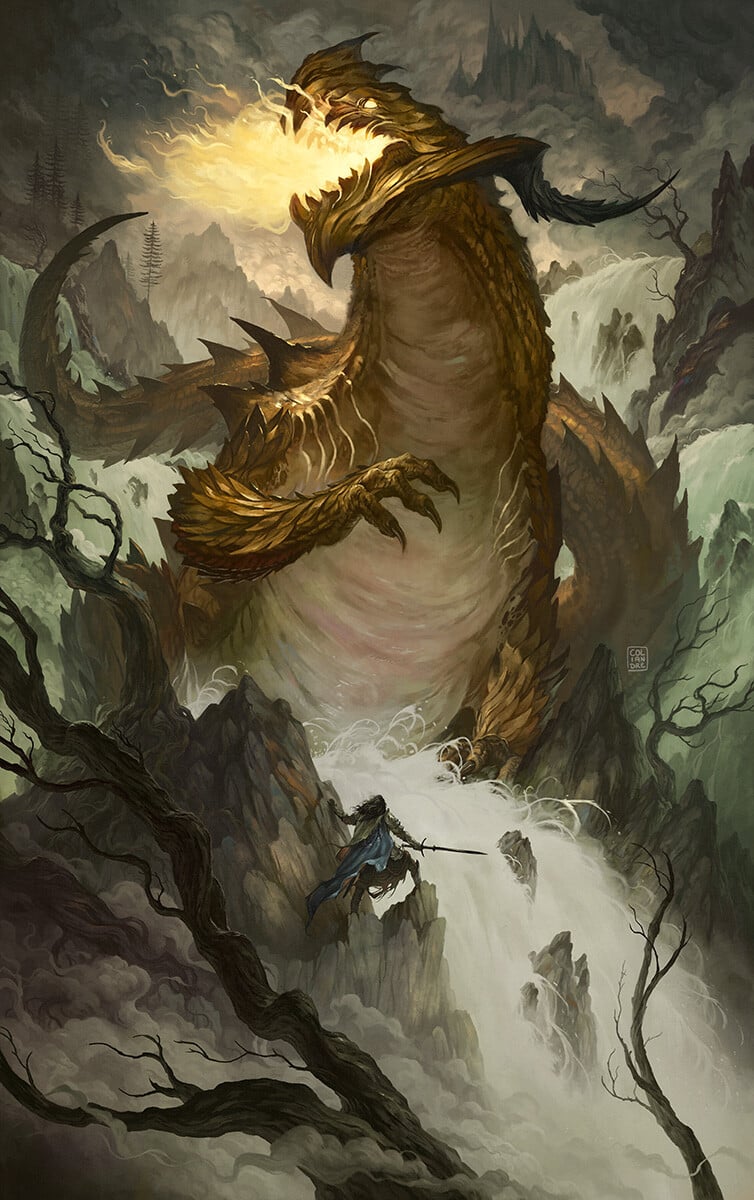
They soon find that the Foalókë (dragon) Glorund is in the area and might have Túrin in his grasp, so Mavwin and Nienóri steel themselves and head out to face the Foalókë and try to save him.
During this time, there were some exciting transitions that Tolkien was still working through (which is apparent in the notes). Túrin had changed his name to Turambar (or Mormakil) when he became an outlaw, which is at the same time Mavwin and Nienóri are looking for him. So when they questioned the people of the wood looking for Túrin, many of the Rodothlim they questioned didn’t know who Túrin was, because they only knew him as The Mormakil or Turambar. Without this comedy of errors, they wouldn’t have had to venture out and try to fight against Glorund because Turambar (as we’ll call him moving forward) had already escaped.

But alas, they sought the Foalókë and were caught in his glamor: “‘Seek not to cajole me, woman,’ sneered that evil one. ‘Liever would I keep they daughter and slay thee or send thee back to thy hovels, but I have need of neither of you.’ With those words, he opened full his evil eyes, and a light shone in them, and Mavwin and Nienóri quaked beneath them, and a swoon came upon their minds, and them seemed that they groped in endless tunnels of darkness, and there they found not one another ever again, and calling only vain echoes answered, and there was no glimmer of light (pg 99).”
Oof. This passage is probably as close to horror as anything in Tolkien. The dragon has put their minds in a cage, and mother and daughter never see each other again. They don’t recognize each other, and this transcends into the rest of the story. We follow Nienóri as she leaves and ends up living with wood rangers. In the woods, “she seemed to herself to awake from dreams of horror nor could she recall them, but their dread hung dark behind her mind, and her memory of all past things was dimmed (pg 99).”
For the rest of the tale, Tolkien writes Nienóri in this fashion. Confused and haunted, as if something is beyond her understanding or grasp, and this confusion leads to Turambar’s next tragedy.
Turmabar eventually gets to the hovel where the wood rangers live and he sees a beautiful young woman whom he calls Níniel because she cannot remember her name. He calls her this because she is distraught and crying when he finds her, and Níniel means little one of tears.

Nienóri was just a baby the last time Turambar saw her, so he doesn’t recognize her, and there are copious liner notes from Tolkien himself which indicate how careful he needs to be, not to mention the name Túrin and give away the surprise. Because Turambar does not recognize her and Níniel does not remember her past, the two begin to court, which leads to the quote that opens this essay and Túrin’s next tragedy.
It seemed as though there was peace in Hisilómë, as The Foalókë didn’t know where they were hiding. For a time, there was prosperity, and “Like a king and queen did Turambar and Níniel become, and there was song and mirth in those glades of their dwelling, and much happiness in their halls. And Níniel conceived (pg 103).”
There is Turmabar’s fourth tragedy. Unbeknownst to him, he met a familiar and beautiful face in his sister, wooed and married her, then had a child through incest.
They lived in happy ignorance until a traitor found their home in the forest. Mîm the dwarf, known as Mîm the petty dwarf in The Silmarillion, betrayed their whereabouts.
The Foalókë charged out through the woods and smote some of the woodsmen. Turambar, being their chief, decided that he needed to do something.
“Now when Turambar made ready to depart then Níniel begged to ride beside him, and he consented, for he loved her and it was his thought that if he fell and the drake lived then might none of the people be saved, and he would liever have Níniel by him, hoping perchance to snatch her at least from the clutches of the worm, by death at his own or one of his liege’s hands (pg 104).”
His decision seemed to be sound reasoning at the time, but they were against a terrible foe in Glorund, the Drake who glamorized his whole family, and his wife/sister was still under that glamor. If we know anything about Turambar’s life, we know what will come next.
Join me next week as we conclude Turambar’s tale!
Blind Read Through: The Book of Lost Tales, Part 2, Túrin’s Third Tragedy
“And thereupon Turambar leapt upon the high place and ere Brodda might foresee the act he drew Gurtholfin and seizing Brodda by the locks all but smote his head from his body, crying aloud: ‘So dieth the rich man who addeth the widow’s little to his much. Lo, men die not all in the wild woods, and am I not in truth the son of Úrin, who having sought back unto his folk findeth an empty hall despoiled (pg 90).'”
Welcome back to another Blind Read! This week, we delve back into Túrin’s story and reach a turning point in his life. In addition, we get to experience Túrin’s third tragedy.
We left off last week with Túrin leaning into the Outlaw mentality and choosing that lifestyle in the woods and wilds. As we’ve discussed, Túrin didn’t have the easiest childhood. His father was a thrall to Melko, as were many of his people, and his sister died young. Mavwin, Túrin’s mother, sent him to live with Tinwelint as a ward to that Elven King. He lived with this idea of being an orphan his entire life, even though his mother lived and gave birth to another sister.
In his head, Túrin always felt as though others were looking at him as an outsider, so when he killed Orgol (his first tragedy), he assumed that others were judging him based on his family. It isn’t until he kills Beleg (his second tragedy) that he begins to think less of himself and his contributions to society, so he begins to slide into being an outlaw.
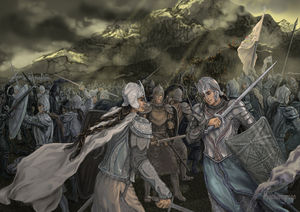
Túrin does not account for the area’s history and how Melko had corrupted things. After we find out about his outlaw shift, there is a meeting with the Rodothlim. To rally them for battle, “for he lusted ever for war with the creatures of Melko (pg 83),” he called for them to: “Remember ye the Battle of Uncounted Tears and forget not your folk that there fell, nor seek ever to flee, but fight and stand (pg 83).”
Túrin needs to take a history lesson. The Battle of Unnumbered Tears (later called in The Silmarillion), also known as Nirnaeth Arnoediad, was so named because of the sheer amount of dead and the Doom of Mandos.
Mandos laid down that curse because the Noldori killed their kin to go after Melko and recover the Silmarils. In that titular curse, Mandos tells the Eldar, “Tears Unnumbered ye shall shed,” In this battle, also known as the Fifth battle in the wars of Beleriand, Morgoth gains ground and begins to take over the land.
So, while Túrin is internalizing the wrongs of his life and turning to violence to assuage his conscience, he forgets that everything that caused the issues was because of the Noldor, not because of him or his deeds, horrendous as they are.
So Túrin leaned into his anger and spoke to Orodreth, a smith, for a weapon because he could no longer touch the sword he killed Beleg with. This creation deviates from what the story later became because Orodreth and not Eöl fashioned Gurthang.

“Now then Orodreth let fashion for him a great sword, and it was made by magic to be utterly black save it’s edges, and those were shining bright and sharp as but Gnome steel may be. Heavy it was, and was sheathed in black, and it hung from a sable belt, and Túrin named it Gurtholfin the Wand of Death; and often that blade lept in his hand of its own lust, and it is said that at times it spake dark words to him (pg 83).”
Orodreth tried to speak against fighting against Melko’s armies, regretting his creation of the Wand of Death, but Túrin was both craving war and trying to atone for his past indiscretions, so he went out and fought every agent of Melko he could find. He became infamous, and it did not go past Melko’s sight. Melko released a great army, “and a great worm was with them whose scales were polished bronze and whose breath was a mingled fire and smoke, and his name was Glorund (pg 84).”
Glorund killed Orodreth, who, even on his death bed, reproached Túrin, blaming him for the destruction his range had caused. Túrin tried to fight, but the dragon had powers Túrin didn’t understand, and the drake charmed Túrin, holding him in place, while Failivrin waws carried away, crying out, “O Túrin Mormakil, where is thy heart; O my beloved, wherefore dost thou forsake me (pg 86).”
She didn’t understand that he had been charmed and thought he was letting the creatures kidnap her.
Túrin was trapped there with the mind games of Glorund until finally, the dragon set him free, allowing him to go after Failivrin or seek out his mother and sister, whom he only knew as a newborn.
He decides to go after his mother, only to find she has fled Dor Lómin. In her place, she left a local high-class man named Brodda to watch over her estate, but Brodda, seeing the wealth to be had, rebranded all her cattle and property as his own.

Túrin had already killed, and now he had someone directly blame him for their misfortune (in Orodreth), and he chose the wrong path to find his mother, succumbing to Melko and Glorung’s deception.
It is at this point that Túrin forsakes morality. He is no longer trying to be an upstanding citizen. Even in his outlaw stage, his actions were to help and save others. It is here that we get the quote at the beginning of this essay, and it is here that we see Túrin’s next tragedy. He has given into his anger and hate, gone over to the dark side (forgive the crossover), and decided to go with full-fledged murder.
Moving forward in his story, he is still an outlaw, but he is no longer an outlaw for the good of the people. He is now an outlaw hell-bent on his emotional trajectory.
Join me next week as we continue on Túrin’s journey!
Magic Does Exist

It’s easy to write the phrase “with everything going on in the world.” There is, and will always be, a never-ending stream of horrible things happening, so perspective is more critical now than ever.
We live in a digital age, where news and op-eds are at our fingertips 24/7, and things like social media have fostered an interesting change to our psyche. We have created perspective silos, where we only see what we want to see, creating division between one another. Then we have politicians who are only out for themselves who are stoking this division.
These kinds of rifts have and will always be around, but one thing we have forgotten as a society, as humans, and as creative beings is that there is still magic in the world; and magic is what will save us from ourselves.

I was driving with my wife this past weekend on the central coast of California celebrating our tenth anniversary, and off the coast, oil rigs were sitting out in the ocean. I had no idea they were there (or that there was a drilling operation so close to our coast), so naturally, being a fantasist, I immediately thought they were some ship. My mind turned to Pirates out in the ocean, sailing the wide blue expanse in search of meaning and freedom and booty.
Of course, I didn’t verbalize this and asked what they were because I couldn’t get the visual out of my head (Though my wife is awesome and knew exactly what I was thinking and why I asked). When she told me what they were, I nodded, and we moved on, but there was magic in the world again for that brief moment. There was still the possibility of a real-life version of the Pirates of the Caribbean, where there were curses and magic and epic fights on the seven seas, where no one really dies, and you always find out that there is just one more item beyond reach that can give understanding and have the world make sense.
People, in this digital age, have forgotten that there is magic in the world. The drive to get clicks, and the pressure to be famous or influence and show how good your life is to strangers online has taken precedence over enjoying the little things.
Speaking of pirates, The Pirates of the Caribbean series was so popular (and Disney in general) because it introduced the world’s elements that were thought impossible.

On the one hand, you have the East India Company, which represents reality, corporations, and the everyday grind. Everything about that concept is about control and making the world smaller. About controlling the magic in the world for profit. The more we know about the world, the less magic there is, the less there is to wonder about, and we end up just accepting that the daily grind is all there is, and the company gets what it wants… good workers that realize there is nothing beyond their Friday paycheck.
Captain Jack introduces us to a character who knows there is magic left in the world. But not magic in the traditional sense. Not witches, wizards, and spells (though that can be a part of it), but wonder and imagination. We are asking people to grow up far too quickly, telling them that the harsh reality is all there is, and disparaging people who want to believe there is something more in the world. We tell people to “grow up,” stop being childish and take things more seriously.
But what does that do for you? If all you can do is internalize the cold, hard reality, it only leaves room for disdain, hatred, and sadness. Then disassociation is the only thing left, which isn’t a healthy alternative.
Fantasy isn’t necessarily escapism but a filter on the lens of the world. Fantasy allows you to experience the world in a way where magic still exists.
There is a reason that Disneyland is “the happiest place on earth,” and it’s because they focus on the individual details. They miss no brush stroke; every rock is overturned. There are hidden Mickeys throughout the park. Each land can let you immerse yourself in the wonder of that world. The details allow you to experience the magic that still exists in our world, so your mind can slip into that magic when you hear a song or see an article of clothing.
Magic and fantasy are not about escapism but realizing that the world isn’t myopic. Life isn’t dictated by corporations or political rhetoric. Life is created and run by magic, and things are still hidden. Look hard enough to find your hidden mickey in the sand, trees, or oceans. Be your own Imagineer and make your own mystery, create your own wonder. Discover your own treasure map that leads to some hidden fantasy, even if you can never find it.
Magic is still alive and well in the world, and we are here to experience it. Work will always be there; go and find your magic. Go and find your purpose.
Blind Read Through: J.R.R. Tolkien; The Book of Lost Tales, Part 2, Túrin’s Second Tragedy

“In that time was Túrin’s hair touched with grey, despite his few years. Long time however did Túruin and the Noldo journey together, and by reason of the magic of that lamp fared by night and hid by day and were lost in the hills, and the Orcs found them not.”
Welcome back to another Blind Read! This week, we cover Turambar’s second tragedy and discover his life and vision of himself as an outlaw and what that means for him moving into the rest of his story.
We left off last week with Túrin leaving Doriath and heading off into the wilds, where he met up with Beleg, an Eldar of the court of Tinwelint. Tolkien spent time developing Beleg later in the Silmarillion (probably to give Túrin’s actions more significant stakes). Still, in this version, he becomes a traveling companion and a Captain against Melko.

The two range in the wilds and hunt orcs and other foul creatures of the darkness. For many of these hunters, the goal was to lessen Melko’s hold on the world and make it a little more accessible for everyday people to wander. For Túrin, it was about killing these foul creatures, which showed his true nature.
In the Silmarillion, Beleg played the role of the conscious. Túrin ran off with the outlaws, and Beleg was sent after him to be a protector and to remind him of his upbringing. There is even a sentiment that Beleg should bring Túrin back if possible, and he is given the Dragon Helm of Dor-lómin to give to Túrin to show that even if he doesn’t come back, they wish him to be safe.
In The Book of Lost Tales, Beleg is already out in the wilds, and Túrin joins him. Their bond is strong, and they become like brothers out in the wilds hunting the creatures of Melko. But living that life can only last so long before life catches up with you.
It wasn’t long before they came across “a host of Orcs who outnumbered them three times. All were there slain save Túrin and Beleg, and Beleg escaped with wounds, but Túrin was overborne and bound, for such was the will of Melko that he be brought to him alive (pg 76).”
Túrin stayed a captive of the Orcs for some time. They abused and beat him to within an inch of his life, and “was Túrin dragged now many an evil league in sore distress (Pg77).”
During this time, Melko unleashed “Orcs and dragons and evil fays (pg 77)” upon the people of Hithlum to either take them as thralls or kill them as retribution for the outlaw brigade led by Túrin.
Meanwhile, Beleg wandered in the wilds, killing evil creatures and looking for his lost compatriots. He did so until he came upon an encampment of Orcs and saw that in this camp was a restrained Túrin. Thus, we get Túrin’s second great tragedy:

“but Beleg fetched his sword and would cut his bonds forthwith. The bonds about his wrists he severed first and was cutting those upon the ankles when blundering in the dark he pricked Túrin’s foot deeply, and Túrin awoke in fear. Now seeing a form bend over him in the gloom sword in hand and feeling the smart of his foot he thought it was one of the Orcs come to slay him or torment him – and this they did often, cutting him with knives or hurting him with spears; but now Túrin feeling his hand free lept up and flung all his weight suddenly upon Beleg, who fell and was half-crushed, lying speechless on the ground; but Túrin at the same time seized the sword and struck it through Beleg’s throat…(pg 80).”
Túrin felt like an outcast because he was a man living with Elves and his accidental killing of Orgof, but now, with the murder of Beleg, he has become a full-fledged Outlaw. It is not in his nature to return to Tinwelint and confess his wrongdoing, even if the Elven King would forgive and pardon him. Túrin internalizes his struggles and becomes depressed in the way only a Man (human) can.
Tolkien wrote the races of Middle-earth (I have still not seen a mention of Beleriand yet in The Book of Lost Tales) to have all range of emotion, but Elves never really seem to get maudlin like Men do. Their immortality gives them a view of the world that eliminates general depression, but Man’s mortality appears to encourage it. We see that slightly in Beren, but it is full front and center for Túrin. His entire story has a sort of “woe is me” feel – even though it’s his fault that these things happen to him. Túrin lives his life in a state of impetuousness, which leads to desperation. In that desperation, he takes events as they come to him without giving them a second thought.
So when he escapes the Orcs with the Elf Flinding, who incidentally is also a bit of an outcast for his actions, they come across a group of wandering Men called the Rodothlim who live in caves.
The Rodothlim “made them prisoners and drew them within their rocky halls, and they were led before the cheif, Orodreth (pg 82).”
Here in the caves of the Rodothlim (which I believe must be a precursor to the Rohirrim), Túrin met Failivrin, a maiden of those people. She quickly met the dreary man and “wondered often at his gloom and sadness, pondering the sadness in his breast (pg 82).”

Despite her affection for him, Túrin couldn’t leave his past behind, “but he deemed himself an outlawed man and one burdened with a heavy doom of ill (pg 82-83).”
The caves of the Rodothlim had a strange effect on Túrin. Those people survived in the wilds because their caves gave them a veil from Melko’s agents and eyes, which gave Túrin a respite from having to face those monsters directly – but it also gave him time to think, dream, and replay his past life. In those caves of safety, Túrin made a mental shift and knew he could never be accepted in any typical setting. He was born an outlaw, and his fate was exclusively intertwined with that life. He decided to lean into the outlaw life, which was just one more bad decision in a long list of bad choices.
Join me next week as we continue on Túrin’s tragic journey!



 Sean McBride
You must be logged in to post a comment.