Blind Read Through: J.R.R. Tolkien; The Book of Lost Tales, part 2, The Tale of Tinúviel, conclusion
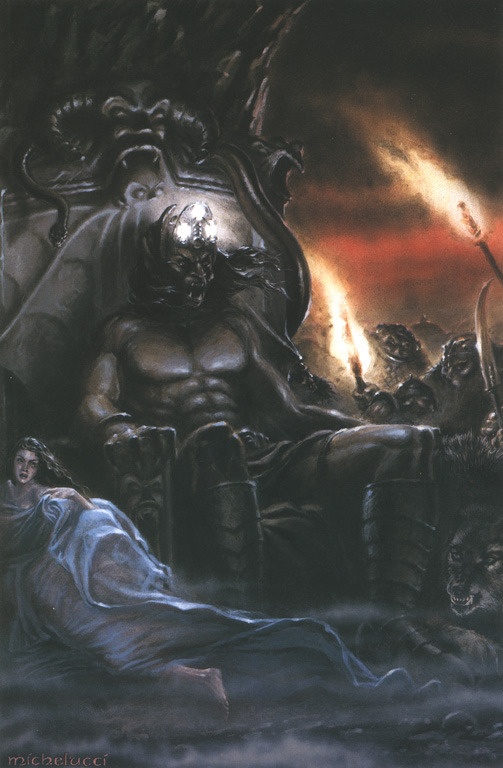
“Lo, the king had been distraught with grief and had relaxed his ancient wariness and cunning; indeed his warriors had been sent hither and thither deep into the unwholesome woods searching for that maiden, and many had been slain or lost for ever, and war there was with Melko’s servants about all their northern and eastern borders, so that the folk feared mightily lest that Ainu upraise his strength and come utterly to crush them and Gwendeling’s magic have not the strength to withold the numbers of the Orcs (pg 36).”
Welcome back to another Blind read! This week, we finish The Tale of Lúthien and reveal more differences between The Book of Lost Tales and The Silmarillion.
We left off last week with Lúthien and Huan saving Beren from Tevildo and the cats. After escaping, they retreated and recovered, but there was still that everlasting desire to go and get the Silmaril back, so they devised a plan.

“Now doth Tinúviel put forth her skill and fairy-magic, and she sews Beren into this fell and makes him to the likeness of a great cat, and teaches him how to sit and sprawl, to step and bound and trot in the semblance of a cat… (pg 31).”
They go to Angamandi and the court of Melko, where they come into contact with Karkaras (an early version of Carcharoth), who was suspicious of Lúthien, but her disguise on Beren held. Lúthien played her magic on the great wolf and put him to sleep “until he was fast in dreams of great chases in the woods of Hisilómë when he was but a whelp… (pg 31).”
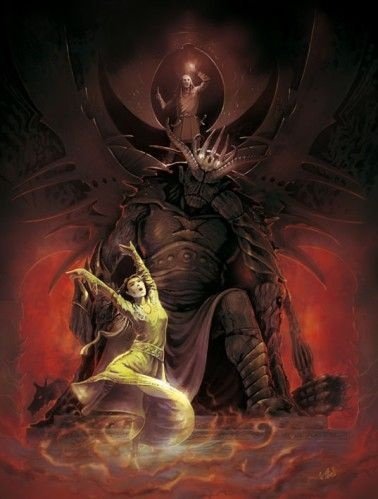
Both Lúthien and Beren make their way to Melko’s throne room, filled with cats and creatures, and Beren blended in with them, and took up a “sleeping” position underneath Melko’s throne. Lúthien on the other hand stood with pride before the Ainu, “Then did Tinúviel begin such a dance as neither she nor any other sprite or fay or elf danced ever before or has done since, and after a while even Melko’s gaze was held in wonder (pg 32).”
Everyone in the chamber, all the cats, thralls, Fay, and even Beren, fell asleep while listening to Tinúviel’s Nightingale voice. Her movements were just as hypnotizing, “and Ainu Melko for all his power and majesty succumbed to the magic of that Elf-maid, and indeed even the eyelids of Lórien had grown heavy had he been there to see (pg 33).”
Tinúviel woke Beren, careful to let everyone else continue to sleep. “Now does he draw that knife that he had from Tevildo’s kitchens and he seizes the mighty iron crown, but Tinúviel could not move it and scarcely might the thews of Beren avail to turn it (pg 33).”
They eventually pry one Silmaril off the crown, but Beren goes for a second one in his greed, only to break his blade and wake Melkor. Tinúviel and Beren fled Angamandi, pursued by Karkaras, the Great Wolf. They battled, and Karakaras bit off Beren’s hand bearing the Silmaril.
But, “being fashioned with spells of the Gods and Gnomes before evil came there; and it doth not tolerate the touch of evil flesh or of unholy hand (pg 34).” So Karkaras began to be burned alive from the inside out and screamed for all he had. The screams of the Great Wolf woke the castle, and Beren and Tinúviel fled for their lives.
They ran with an entire Orc army of Melko on their trail and had many encounters with them but eventually “stepped within the circle of Gwendeling’s magic that hid the paths from evil things and kept harm from the regions of the woodelves (pg 35).” Otherwise known as the Girdle of Melian.
They make their way to the king, and we get the quote that opens this essay, but Tinwelint saw no Silmaril, so they related the tale, and Beren stood before the king and said, “‘Nay, O King, I hold to my word and thine, and I will get thee that Silmaril or ever I dwell in peace in thy halls (pg 38).'”
So Beren went back out into the wilds to find the body of Karkaras and claim the Silmaril, but he didn’t go alone. “King Tinwelint himself led that chase, and Beren was beside him, and Mablung the heavy-handed, chief of the king’s thanes, leaped up and grasped a spear (pg 38).”
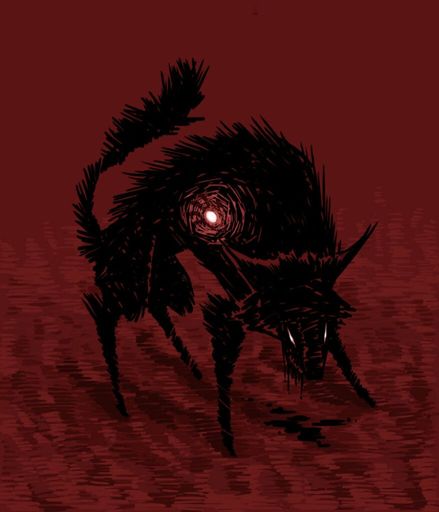
They eventually came upon a vast army of wolves, and among them was Karkaras, still alive but howling in agony. There was a great battle, “Then Beren thrust swiftly upward with a spear into his (Karkaras) throat, and Huan lept again and had him by a hind leg, and Karkaras fell as a stone, for at that same moment the king’s spear found his heart, and his evil spirit gushed forth and sped howling faintly as it fared over the dark hills to Mandos; but Beren lay under him crushed beneath his weight (pg 39).”
Beren was mortally wounded beneath Karkaras, and they tried to nurse him back to health. In the meantime, Tinwelint and Mablung found the Silmaril in Karkaras’ body. Tinwelint refused to take it unless Beren gave it to him to honor the fallen warrior, so Mablung grabbed the Silmaril and handed it to Beren, who, with his dying breath, said, “‘Behold, O King, I give thee the wondrous jewel thou didst desire, and it is but a little thing found by the wayside, for once methinks thou hadst one beyond thought more beautiful, and she is now mine (pg 40).'”
The tale ends with Beren dying, and we get a short interlude of Vëannë telling Eriol that there were many other tales of Beren coming back to life but that the only one she thought was true was the tale of the Nauglafring, otherwise known as the Necklace of the Dwarves.
The tale’s bones are the same all the way through, with some very significant character changes, like the addition of Celegorm and Curufin and the subtraction of Tevildo. Still, quite honestly, these things are entirely necessary because, on its own, this is just a tragic tale. When you add the other elements, the world expands, and the characters gain more agency. Suddenly, Beren’s quest affects far more than just the players in the story, and we get a much broader realization of what Beleriand is, was, and will become.
Join me next week for a short second edition of this tale, some commentary, and some final thoughts!
Blind Read Through: J.R.R. Tolkien; The Book of Lost Tales, part 2; The Tale of Tinúviel, cont.

“Now all this that Tinúviel spake was a great lie in whose devising Huan had guided her, and maidens of the Eldar are not wont to fashion lies; yet have I never heard that any of the Eldar blamed her therein nor beren afterward, and neither do I, for Tevildo was an evil cat and Melko the wickedest of all beings, and Tinúviel was in dire peril at their hands (pg 27).”
Welcome back to another Blind Read! We left off last week with Beren getting captured by Tevildo, Prince of Cats, and Lúthien escaping the tower her father imprisoned her in to go and find and free Beren from his thralldom.
Before the story, let’s review what happened in The Silmarillion.
Lúthien escaped from Doriath and chased after Beren, but where there are cats in The Book of Lost Tales, The Silmarillion had Wolves. Beren was captured by Sauron, the Master of Wolves (many of his minions in this story were werewolves, and he even commanded the Wolf King Carcharoth), and on her way to find him, Lúthien meets up with Huan, the Hound of Valinor.
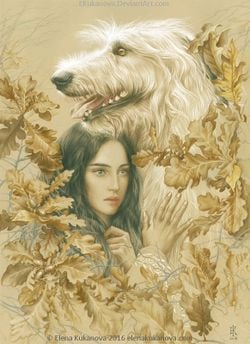
Huan takes Lúthien to his masters, Celegorm and Curufin, who were Fëanor’s sons (Eldar who swore to get the Silmarils back at the cost of all else). The Book of Lost Tales is a significant departure from the older story because these two brothers played a nefarious role in the remaining history of Beleriand. They caused strife and trouble for our heroes many times and generally stood in the way only because of their oath, and they never appear in the earlier version.
This deception is the first instance of their devious natures. They instructed Huan to bring Lúthien before them and once there, Celegorm devised a plan to marry her because of her beauty, but more importantly because of her lineage. Celegorm was seeking power, plain and simple. He tricks Lúthien, brings her to Nargothrond, and imprisons her until his plan can be complete.
Here, Huan felt pity for Lúthien, who only wanted to save her love, and felt disgust for his master. Huan frees Lúthien, leading her to Angband to confront Sauron and free Beren.
When they get there, Sauron sends his werewolves out to kill them, but Huan kills them one by one. Sauron then shapeshifts and changes himself into a werewolf (doubtless being one of those quintessential bad guys who say, “If you want something done right, you gotta do it yourself.”), and heads out to meet them. There is a pitched battle, with Sauron changing into different shapes and trying other tactics. Still, eventually, Huan defeats him, and Sauron flees in the form of a Vampire after leaving the keys to the prisons for Huan and Lúthien to take.
This fight shows the absolute power of Huan. Sauron gained strength and influence over the remaining years of his life, but the fact that Huan and Lúthien were able to best him in battle when, later on, it took armies to stand up to him is a testament to Huan’s strength and Lúthien’s ingenuity.

They freed Beren and fled Angband, only to come across our favorite dastardly Eldar, Celegorm, and Curufin. They battled, and Beren won, deepening their shame and anger. Not only were the great sons of Fëanor defeated, but a human bested them to boot!
Beren then snuck back to Angband after both Huan and Lúthien slept, determined to get the Simaril and prove his worthiness, but when they woke and found him gone, they disguised themselves as a vampire and werewolf and went after him. They got to Morgoth’s chambers, and Lúthien used her magic to put everyone to sleep and Beren cut a Silmaril from Morgoth’s crown before escaping from the stronghold.
As they exited, Carcharoth, the King of Wolves jumped out and attacked them, biting off Beren’s hand that held the Silmaril and thus halting their quest. Huan summoned The Eagles of Manwë (you might remember these majestic creatures from the end of The Return of the King when they rescued Frodo and Sam from Mount Doom), and they escaped from Angband.
In The Book of Lost Tales, Sauron is not present. Instead, it’s Tevildo who has Beren captured. Lúthien still meets up with Huan, but we have a sort of natural cat-and-dog relationship there:
“None however did Tevildo fear, for he was as strong as any among them, and more agile and more swift save only than Huan Captain of Dogs. So swift was Huan that on a time he had tasted the fur of Tevildo, and though Tevildo had paid him for that with a gash from his great claws, yet was the pride of the Price of Cats unappeased and he lusted to do a great harm to Huan of the Dogs (pg 21).”
Tinúviel travels with Huan to Angamandi (the early version of Angband) and finds a resting cat sentry just before its gates. Tinúviel asks to speak with Tevildo and plays to the guard’s pride to get her in to gain an audience.

When she is brought before Tevildo, she asks to speak with him privately, but he is not humored:
“‘Nay, get thee gone,’ said Tevildo, ‘thou smellest of dog, and what news of good came ever to a cat from a fairy that had dealings with dogs (pg 24)?”
Tinúviel sweet-talks her way in and spies Beren in the kitchen doing his thrall duties. She speaks loudly, letting Beren know that she’s there, and then we get the opening quote of this essay, where she divulges Huan’s plan: Huan is hurt and helpless just outside in the forest, the cats must kill him!
“Now the story of Huan and his helplessness so pleased him (Tevildo) that he was fain to believe it true, and determined at least to test it; yet at first he feigned indifference (pg 27).”
Tevildo and a small group of Cats went out to try and end Huan, only to fall into the trap. Huan killed all but Tevildo, who barely escaped and lost his golden collar before fleeing up a tree.
Tinúviel took the golden collar and brought it before Tevildo’s court and got all of his prisoners released, along with a curiously named Gnome.
“Lo, let all those of the folk of the Elves or of the children of Men that are bound within these halls be brought forth,’ and behold, Beren was brought forth, but of other thralls there were none, save only Gimli, an aged Gnome, bent in thraldom and grown blind, but whose hearing was the keenest that has been in the world, as all songs say (pg 29).”
This name was undoubtedly used again once the languages were fleshed out and Tolkien realized that Gimli was much more of a dwarven name than an Elvish name, but he doesn’t appear again in this story (that I’ve read so far), so I think it was just a name Tolkien loved.
Lúthien, Beren, and Huan escaped, and the cats were ashamed. Morgoth’s anger was so great that they lost face, and the power of the cats was never the same from then on.
We’re getting close to the end! Join me as we cover the first written ending to The Tale of Tinúviel next week!
Blind Read Through: J.R.R. Tolkien; The Book of Lost Tales, part 2; Beren and Lúthien

“One day he was driven by a great hunger to search amid a deserted camping of some Orcs for scraps of food, but some of these returned unawares and took him prisoner, and they tormented him but did not slay him, for thier captain seeing his strength, worn through he was with hardships, thought that Melko might perchance be pleasured if he was brought before him and might set him to some heavy thrall-work in his mines or in his smithies. So came it that Beren was dragged before Melko, and he bore a stout heart within him nonetheless, for it was belief among his father’s kindred that the power of Melko would not abide for ever, but the Valar would hearken at last to the tears of the Noldoli, and would arise and bind Melko and open Valinor once more to the weary Elves, and great joy should come back upon Earth (Pg 14-15).”
Welcome back to another Blind Read! This week we travail the beginning of the quest for a Silmaril and the humble beginnings of the story in The Book of Lost Tales.
We left off last week with Beren heading out to get the Silmaril from Melkor’s crown to curry favor of Tinwelint and acquire Tinúviel’s hand in marriage. Immediately Beren is in dangerous land:
“Many poisonous snakes were in those places and wolves roamed about, and more fearsome still were the wandering bands of the goblins and the Orcs – foul broodlings of Melko who fared abroad doing his evil work, snaring and capturing beasts, and Men, and Elves, and dragging them to their lord (pg 14).”

Beren was nearly captured by Orcs numerous times, battling all manner of creatures on his way to Angamandi (Melkor’s hold in the Iron Mountains). “Hunger and thirst too tortured him often, and often he would have turned back had not that been well neigh as perilous as going on (pg 14).”
These travels lead us right to the quote that opens this essay. Beren angered Melkor because he represented the kinship between Elves and Men “and said that evidently here was a plotter of deep treacheries against Melko’s lordship, and one worthy of the tortures of Balrogs (pg 15).”
Beren gave Melkor a speech that seemed inspired by the Valar and moved Melkor. Rather than killing him, Melkor decided that he should be sent to the kitchen and become a Thrall of Tevildo, Prince of Cats.
I want to step back here and review what changes Tolkien made to the tale over time.
The framework of the story is the same; however, In The Silmarillion, Beren left Neldoreth (The forests of Thingol and Melian) and made his way to Nargothrond to garner the help of Finrod Felagund, Elven King. He recalled Finrod’s vow to help Barahir’s (Beren’s father) kin, and Finrod agreed to help Beren in his quest for the Silmaril.
Finrod gathered a group and disguised them all as Orcs to get close to Angband, but Sauron, the future Dark Lord, became suspicious of the group and captured them. He sent them to a deep pit and sent werewolves to kill them, which Finrod killed with his bare hands. However, he was mortally wounded and thus ended one of the great Elven Kings of legend.

Tolkien’s process of bringing in Finrod fills out the whole Legendarium much more because The Book of Lost Tales is just that, tales; disparate and singular. These are a collection of stories rattling around in Tolkien’s head which built the history of a world, but he needed connective tissue (and a lot of editing) to bring everything together.
Finrod and Fëanor’s sons, Curufin and Celegorm, become the connective tissue, rather than Tevildo, the Lord of Cats, who doesn’t appear beyond The Book of Lost Tales.
So now that Beren is in captivity, Lúthien can feel that something has gone wrong, so she goes to her mother Gwendeling (Melian) and asks her to use her magic and see if Beren still lives:
“‘He lives indeed, but in an evil captivity, and hope is dead in his heart, for behold, he is but a slave in the power of Tevildo Prince of Cats (pg 17).'”
So she went to her Father, Tinwelint, who was angered that she would want to go after Beren. She also asked her brother Dairon, who scoffed at the idea of her heading off into the wilds, so he went to Tinwelint and tattled on his sister (Daeron in The Silmarillion was an unrequited lover instead of brother, and went to Thingol (Tinwelint) to stop her, and hopefully save her. Tinwelint, in his anger, put her as far away from danger as punishment as he could:
“Now Tinwelint let build high up in that strange tree, as high as men could fashion thier longest ladders to reach, a little house of wood, and it was above the first branches and was sweetly veiled in leaves (pg 18).”
Stuck in the tree, with servants bringing her food and water and then removing the ladders so she couldn’t follow, Tinúviel’s yearning for Beren grew. She stayed up there for a while until she got a vision from the Valar that Beren was still alive and held in captivity, a thrall to Tevildo tasked with hunting for the great cats. Horrified that he was there because of her, and more importantly, the love that kept growing because she could not stop thinking of him, she devised a plan.

“Now Tinúviel took the wine and water when she was alone, and singing a very magical song the while, she mingled them together, and as they lay in the bowl of gold she sang a song of growth, and as they lay in the bowl of silver she sang another song, and the names of all the tallest and longest things upon Earth were set in that song… and last and longest of all she spake of the hair of Uinen the lady of the sea that is spread through all the waters (pg 19-20).”
Remember that the whole point of writing these tales was to build a mythology for England. You can see from reading them that Tolkien was heavily influenced by other fairy tales he read, both in preparation and for study.
Tinúviel rubbed her head in the mixture, and her hair grew to great length, much like Rapunzel did to escape her tower.
Unlike Rapunzel, Tinúviel fashioned a rope out of her hair. She refused anyone from coming up to her little tree house until she finished. Then dressed in a black cloak, she escaped and headed north to go and rescue Beren.
This part of Lúthien’s story is the tale of Rapunzel, except that Tolkien flipped the script and created a strong woman to go and rescue her man.
Join me next week as we continue the story, find the differences with The Silmarillion, and generally have a great time!
Blind Read Through: J.R.R. Tolkien; The Book of Lost Tales, part 2, Beren’s Beginnings
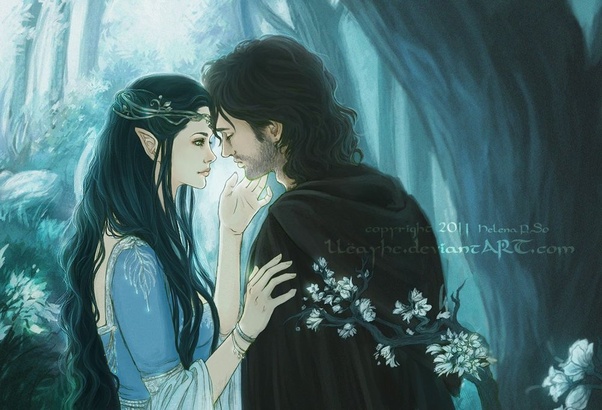
“‘Why! wed my Tinúviel fairest of the maidens of the world, and become a prince of the woodland Elves – ’tis but a little boon for a stranger to ask,’ quoth Tinwelint. ‘Haply I may with right ask somewhat in return. Nothing great shall it be, a token only of thy esteem. Bring me a Silmaril from the Crown of Melko, and that day Tinúviel weds thee, an she will (pg 13).'”
Welcome back to another Blind Read! This week we dive into the Tale of Tinúviel, discover the differences between The Book of Lost Tales and The Silmarillion, as we begin one of Tolkien’s greatest tales.
We left off last week setting the stage for how Tolkien adjusted over time to have the story fit into his Legendarium. This week, we’re going to learn a bit more about Beren and get started on the tale itself!
Tolkien begins the tale with the lineage of Tinúviel and Dairon, as discussed last week, and then transitions into the story itself. “On a time of June they were playing there, and the white umbrels of the hemlocks were like a cloud about the boles of the trees, and there Tinúviel danced until the evening faded late, and there were many white moths abroad (pg 10).”
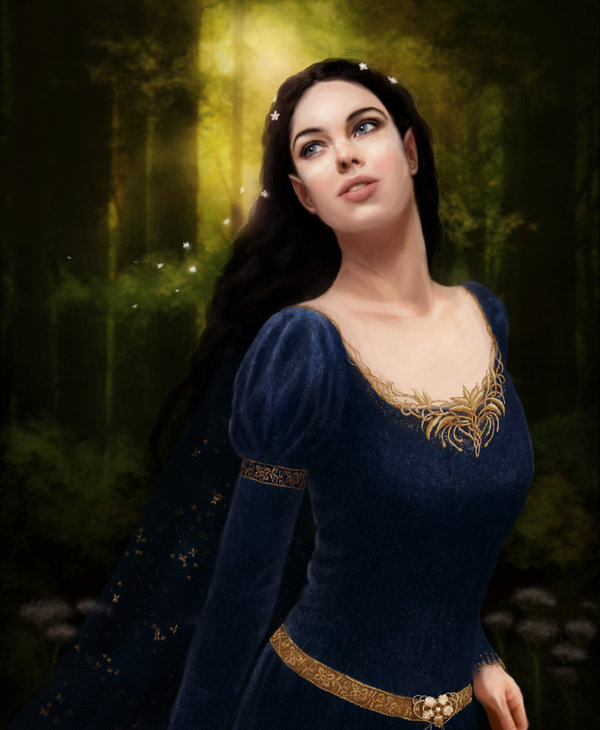
This play was a favorite pastime for both Tinúviel and Dairon. Dairon would play his music, and his sister would dance and sing like a nightingale in the forests of what would eventually be known as Doriath.
“Now Beren was a Gnome, son of Egnor the forester who hunter in the darker places in the north of Hisilómë. Dread and suspicion was between the Eldar and those of thier kindred that had tasted the slavery of Melko, and in this did the evil deeds of the Gnomes at the Haven of the Swans revenge itself (pg 11).”
Beren’s Genesis is an exciting story because while Tolkien was developing it early on, Beren was an elf (or, as Tolkien called them in The Book of Lost Tales, Gnomes).
The reason I chose the above quote was twofold. The first is the change of who Beren’s father was. In the Silmarillion, Beren is the son of Barahir and a descendant of Bëor, who was the leader of the first Men to come to Beleriand.
Barahir was a noble Man (When I capitalize “Man,” I’m using it in Tolkien’s manner, meaning human) who rescued Finrold Filagund from Dagor Bragollach (the Battle of Sudden Flame, otherwise known as the Fourth Battle of Beleriand), and received Finrold’s ring, which was later an heirloom of Isildur in Númenor.
In The Book of Lost Tales, Beren’s father is a Gnome named Egnor, who came to Beleriand early and became a thrall of Melkor. He eventually escaped and fathered Beren, but there was an intense distrust of any thrall of Melkor between the Gnomes.

So then Beren, when he comes across his Nightingale Tinúviel dancing in the forest, is the son of an outcast, which makes Tinwelint, Tinúviel’s father, very skeptical of him, because he is the son of someone who was a thrall of Melkor. Could that thralldom have been passed on? How could Tinwelint possibly trust him to be around his daughter?
Tolkien eventually wanted to change the storyline slightly, but the changes had the same effect. Beren became a Man instead of a Gnome, but Thingol was prejudiced against Men for two reasons. The first was because Men are attracted to power, and they woke after Melkor had done his earlier horrible deeds, so many Men latched onto his passion and became followers of Morgoth, the Dark Lord.
To the Elves, this was as bad or worse than thralldom. In the Silmarillion, it took many acts of Men to get Elves to trust them, and even then, they trusted the individual but still held a healthy distrust of the race.
The second reason Thingol didn’t like Beren and Lúthien’s connection was that Beren was a Man and thus mortal. If he let Lúthien fall in love with a mortal man, she would only have pain to look forward to because even though Men at this time in the Legendarium lived for over a hundred years, Elves were immortal. What was Lúthien to do when Beren died? We see this echo in The Lord of the Rings with Elrond as he speaks to Arwen about loving Aragorn.
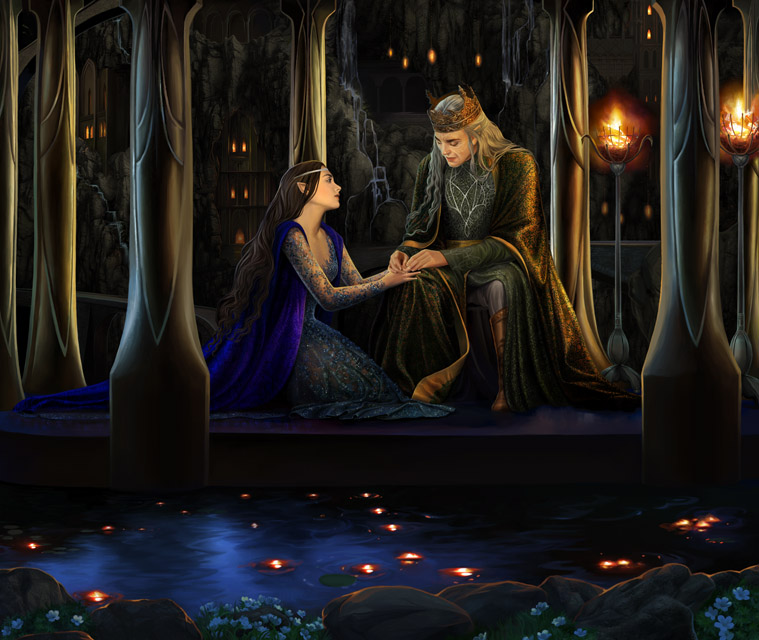
So in both books, Tinwelint/Thingol makes a deal with Beren.
“‘Why! wed my Tinúviel fairest of the maidens of the world, and become prince of the woodland Elves – ’tis but a little boon for a stranger to ask,’ quoth Tinwelint. ‘Haply I may with right ask somewhat in return. Nothing great shall it be, a token only of thy esteem. Bring me a Silmaril from the Crown of Melko, and that day Tinúviel weds thee, an she will (pg 13).'”
Tinwelint knows that he is sending Beren off to his death. In the Book of Lost Tales, not a single Elf had gone up against Melkor because they knew him to be too powerful. Knowing that Beren’s father was a Thrall of Melkor, Tinwelint was probably hoping that Beren would have some genetic predisposition to stay under Melkor’s arm.
Nonetheless, Beren accepted:
“This indeed did Beren know, and he guessed the meaning of their mocking smiles, and aflame with anger he cried: ‘Nay, but tis too small a gift to the father of so sweet a bride. Strange nonetheless seem to me the customs of the woodland Elves, like the rude laws of the folk of Men, that thou shouldest name the gift unoffered, yet lo! I Beren, a huntsman of the Noldoli, will fulfil thy small desire,’ and with that he burst from the hall while all stood astonished (pg 13-14).”
Beren was off to go and collect the Silmaril, even though he knew it was a setup, but Tinwelint didn’t realize that as soon as night would fall, Tinúviel would steal away in the night to follow her love.
Join me next week as we continue the Tale of Tinúviel!
Blind Read Through: J.R.R. Tolkien; The Book of Lost Tales, part 2, The Lineage of Tinúviel

“Lo now I will tell you the things that happened in the halls of Tinwelint after the arising of the Sun indeed but long ere the unforgotten Battle of Unnumbered Tears. And Melko had not completed his designs nor had he unveiled his full might and cruelty (pg 10).”
Welcome back to another Blind Read! This week we begin Tolkien’s premier work in earnest and dissect the differences between what is in The Book of Lost Tales and what would eventually come in The Silmarillion.
The opening quote of this essay introduces the story to the reader, setting the stage for the events to come, but then Tolkien takes a step back and talks of the Elves of Doriath (which were not called such in this early version).
“Two children had Tinwelint then, Dairon and Tinúviel, and Tinúviel was a maiden, and the most beautiful of all the maidens of the hidden Elves, and indeed few have been so fair, for her mother was a fay, a daughter of the Gods; but Dairon was then a boy strong and merry, and above all things he delighted to play upon a pipe of reeds or other woodland instruments, and he is named now among the three most magic players of the Elves… (pg 10).”
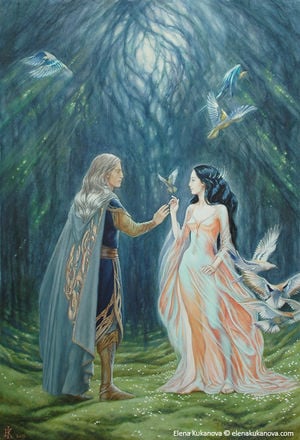
If you have read The Silmarillion, you will probably recognize Tinúviel, and also Dairon as close to a character who stuck around. Still, otherwise, the names of the rest of the characters are entirely different.
Starting with our Titular character, Tinúviel, we know she kept that name in The Silmarillion. It’s the name Beren gave her because it means Nightingale, and he called her that when he found her dancing and singing in the forest. Her name changed to Lúthien, but there is still enough of a thread that it’s easy to keep everything in order.
Next, we have Tinwelint, who gained many names in the future as Tolkien began to develop his languages. Tinwelint became Elwë Singollo, leader of the hosts of the Teleri Elves, along with his brother Olwë. When Elwë led his people from Cuiviénen to Beleriand (the Teleri were known as the Last-comers, or the Hindmost, because, well, they were the last to come to Beleriand of the Eldar), he settled in the forests of Doriath (Where Beren saw Lúthien dancing). He ruled there under his better-known name, Elu Thingol.
Gwendeling, his wife, was not mentioned in the above quote but was also known as Wendelin in the Book of Lost Tales. She is a fay who falls in love with Tinwelint, marries him, and has two children.

Gwendeling, in my opinion, is how Tolkien decided to make the shift for the Maiar because, through the development of the Lay of Lúthien, he understood that women should play a much more significant role than he had initially been written (probably because of the influence of Edith). Gwendeling needed to possess powers of influence, most notably creating the Girdle of Melian, a protective shield over Doriath.
Because of this more extensive influence, Tolkien changed her lineage, and she became a Maiar, along with all of the other “children of the Valar” or Fay who never had a specific history. Doing so enabled Tolkien to have the Maiar keep their power set while at the same time lessening the ability of the Valar to have children (because if they are immortal, what is to stop them from continuing to have children who could potentially mess with the timeline)?
So Gwendeling became Melian the Maiar but stayed wife to Eru Thingol. That enabled Tolkien to make Lúthien a more robust character because she is the daughter of a demi-god and an immortal, but it left him in a strange quandary. In the book of lost tales, Tinúviel had a brother Dairon, and if he were to remain, he would also have to be a little more potent than the other Eldar because of his mother’s blood.
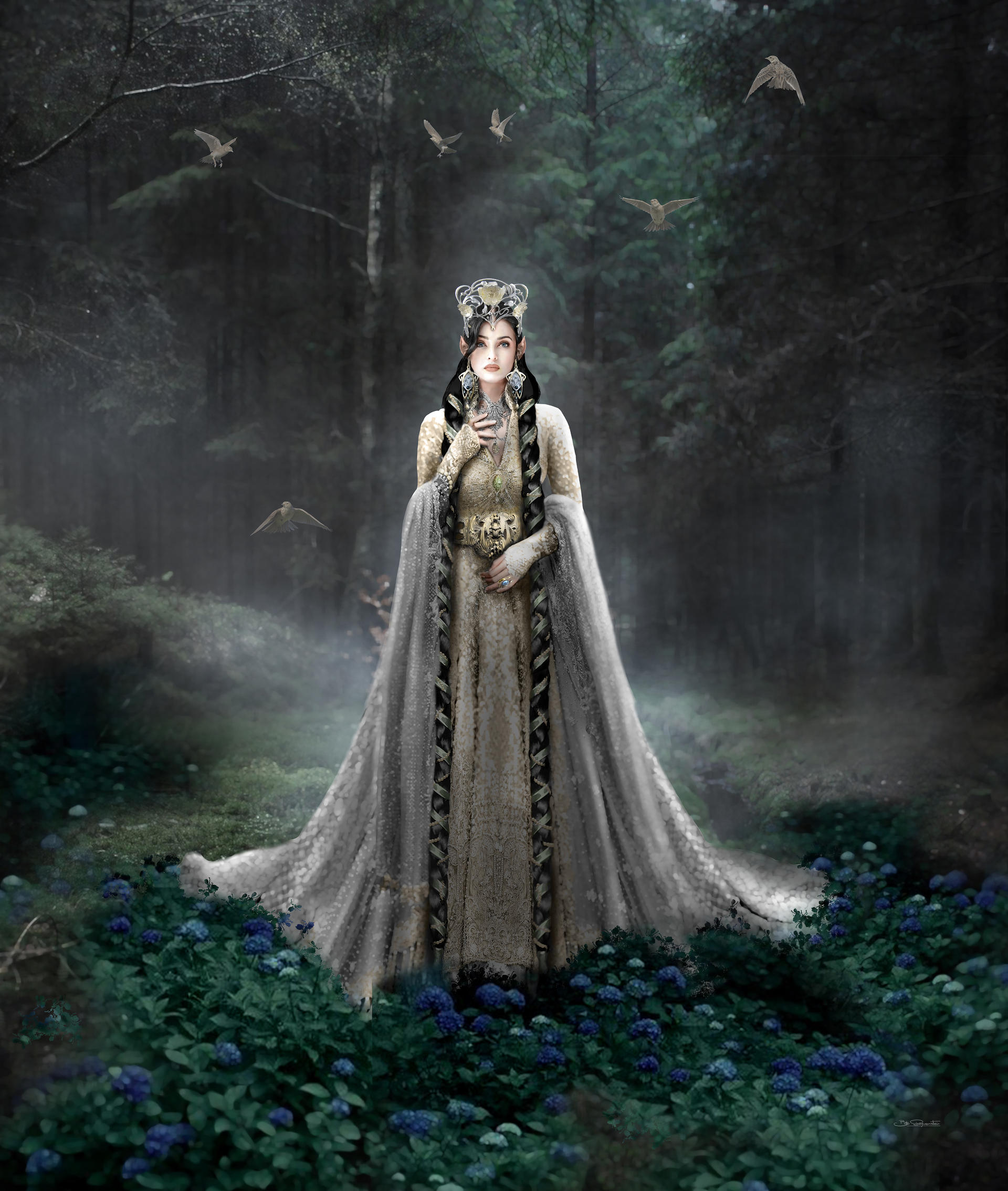
Dairon in the Book of Lost Tales is very talented, but one of those kids without any drive, as we see from the quote above. What he did possess, however, was an uncanny ability for music. He was considered the third-best “magic player” in the land, behind Tinfang Warble and Ivárë. You might remember Tinfang Warble from The Book of Lost Tales, part 1, because he was the half-fay flutist in the Cottage of Lost Play.
To adjust this inequity of power, Tolkien decided to slightly change Dairon’s name to Daeron, who then became one of the greatest minstrels of all time; in fact, the only being to come close to him was Maglor, Fëanor’s son (who is probably the later iteration of Ivárë). However, he became just a regular Eldar, no longer Thingol and Melian’s son, but rather a trusted loremaster of Thingol. More importantly, he was deeply in love with Lúthien.
This adjustment makes for a slightly better tale because rather than her brother betraying her excursion after Beren, it is an unrequited lover looking out for her best interest when he betrays her trust and tells Thingol that she went after Beren.
That takes care of the family, but what then of Beren? The most provocative change that Tolkien made here is that in the Book of Lost Tales, part two, is that Beren is an elf, not a man.
I believe he did this for several reasons, but two of them stand out to me the most:
- Men were not awake yet. At the end of the Book of Lost Tales, part 1, we see that they are children lounging by the Waters of Awakening. Tolkien didn’t spend time developing them like in The Silmarillion. Plus, The Silmarillion is considered the history of the Elves, even though much more happens there, so it makes sense that Beren would be an elf early on.
- Changing Beren to a Man adjusts the Legendarium in a fun and dynamic way. Now we have the dichotomy of the difference between Elves and Men and what that would mean for them to come together, fall in love, and potentially have children. The remainder of the time in Middle-earth stems from this relationship, so Tolkien needed to adjust it.
That was a lot to break down in just the opening pages! Join me next week as we dive into the story proper!




 Sean McBride
You must be logged in to post a comment.