Blind Read Through: H.P. Lovecraft; The Alchemist
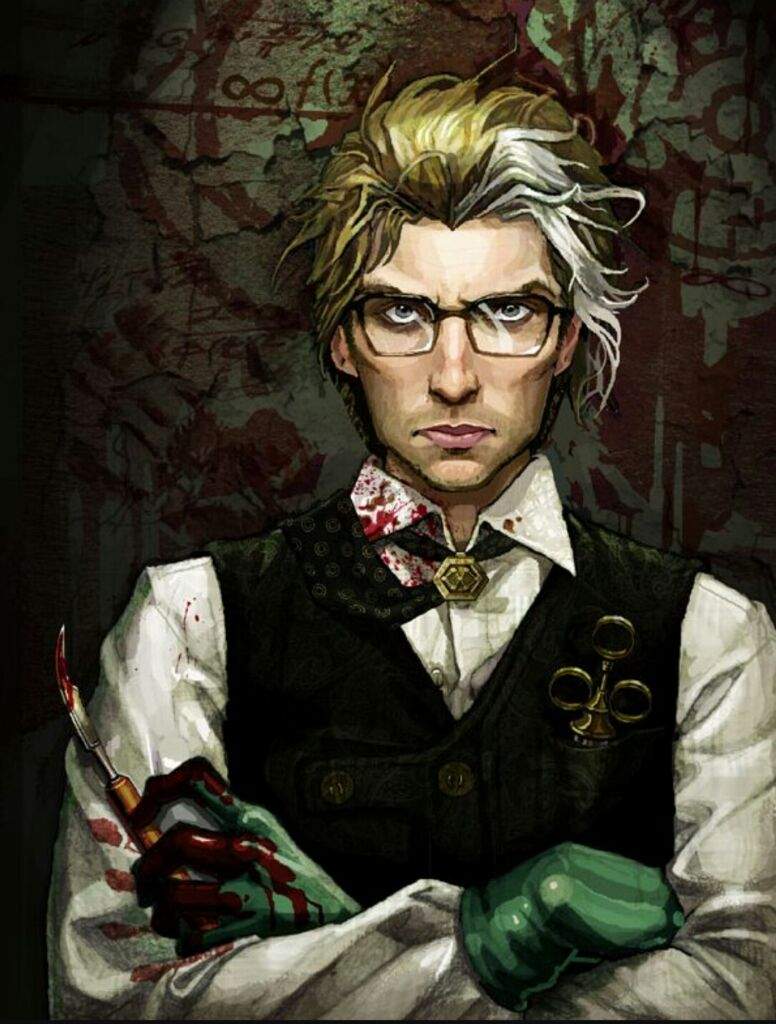
“At this time, my belief in the supernatural was firm and deep-seated, else I should have dismissed with scorn the incredible narrative unfolded before my eyes.”
Welcome back to another Blind Read! We’re diving back into another one of H.P. Lovecraft’s Juvenilia… The Alchemist. This was the first story I’ve read from Lovecraft that I truly feel that he had not gained his writing chops before starting. The narrative is obviously unpracticed and the plot is loose, with a number of issues.
The major thing that jumps out at me is that, unlike his other stories where he relies on inference for horror and terror, in this one he goes right to it and calls a spade a spade. The antagonists are father and son and they are evil. Flat out. Lovecraft even goes so far as to state that the father “…burnt his wife alive as a sacrifice to the Devil, and the unaccountable disappearance of many small peasant children were laid at the dreaded door of these two.” OK. That’s bad enough. We can probably leave it there. We know that these two are corrupt and irredeemable. We know they are the antagonists, but Lovecraft takes it a step further.
“…the evil old man loved his offspring with fierce intensity, whilst the youth had for his parent a more than filial affection.”
OK eww.
I hope I misunderstand this quote, and I hope it means something other than physical love, though I don’t know what else would be more than filial. Even more bothersome, Lovecraft states “…through the dark natures of father and son ran one redeeming ray of humanity,” meaning that their “more than filial love” is seen as a redeeming quality. Hmm. Mayhaps we’ve seen a little into why Lovecraft became such a recluse.
But let’s dig into the story, shall we?
A young man is locked away in a tower because the “…restriction was imposed upon me because my noble birth placed me above association with such plebeian company.” (though really it was because of the curse, but more on that later) Because of this isolation our narrator spends the majority of his time reading over old archaic tomes, but “Those studies and pursuits which partake of the dark and occult in nature most strongly claimed my attention.”
Through these tomes he reads of a man by the name of Michel Mauvais and his son Charles, also known as Le Sorcier. Mauvais, an evil sorcerer who strove for “such things as the Philosopher’s Stone or the Elixir of Eternal Life.” Meanwhile the Count, our narrator’s ancestor, finds one day that his son is missing and immediately goes to Michel Mauvais’ house and kills him for the murder Godfrey, his son. It is later found that Godfrey had just wandered off and eventually came back, though too late to save Mauvais. Le Sorcier curses the count and his ancestors, stating that every man in his lineage will die at the age of 32.
The tome tells how each ancestor of our narrator dies at that age. Eventually on the narrator’s 32nd birthday, Le Sorcier appears and says that it was actually he that had lived these past 600 years and had killed every one of the Narrators kin on their 32nd birthday to ensure the curse continues. He takes the Elixir of Life to help him in this capacity. Here the tale concludes.
We know the narrator wins the inferred scuffle, because he lives to tell the tale. We also know he steals the Elixir of Eternal Life from Charles Le Sorcier because the narrator tells us that the events he described were 90 years prior.
There are two possible outcomes here. The first is how the narrator tells it: he kills Le Sorcier, takes the drought, and lives forever in his tower. The second is that the narrator is none other than Le Sorcier himself, and the earlier story of being holed up was a hoax. Neither one of these are well thought out conclusions however. Either one of these outcomes leave a large number of plot holes, even in this seven page story. Unfortunately I felt this was Lovecraft’s weakest story of which I’ve read so far.
What do you think?



 Sean McBride
The ending seems different to me. The current Count Antoine kills the sorcerer. He isn’t willing to have more children, just in case the curse is still around, but he has plenty of gold. He fixes up his chateau and lives to be 90 which is a reasonable age. He dies. He’s sharing his story before his death.
June 19, 2024 at 12:26 pm
I do like your interpretation. It would also give a redemption we dont regularly see in Lovecraftian characters, but which is far more likely here since it was one of his earlier works.
June 20, 2024 at 2:24 am
okay coming to this a year late but it is because I just read this story and was wondering if it felt a little weaker. That said I think there is some power to the ending if looked at as a “fate worse than death.” Basically, Lovecraft’s focus and dread seems to be centered not on the attempted murder but on the fate of the sorcerer, who survives his ungodly maiming and is a broken thing on the floor. The assumption is that the sorceror CANNOT die by pretty much any means and so I think Lovecraft intended him to be left there, unable to move or fully heal but unable to die. I think the author is not just sharing a story but telling people what is in his castle, locked up. This fits well with Lovecraft’s latter works where the character isn’t killed but left to go insane or become something other than human. Here it seems to be a warning on the dangers of revenge and possibly a moral message about bad things happening to bad people.
September 24, 2025 at 3:41 pm